Decide where to go and keep progress moving
Daily Management asks, “are we on plan today?”. Operational Strategy and Delivery asks, “where are we going, what must change and are our agreed priorities moving us towards the future state?”
Depending on the starting point, we help Leadership teams clarify their operational priorities or translate an existing strategy into a practical, shared, visible plan. This means agreeing the intended outcomes. Making choices across Safety, People, Quality, Delivery, Cost and Environment, defining clear owners, milestones and measures.
A visible master plan, supported by a KPI tree, Obeya, A3s, and regular progress management reviews, connects strategic priorities with coordinated action across functions. It makes dependencies, delays and decision point visible before they prevent delivery.
The objective is not to create another strategy document or reporting meeting. It is to prevent important priorities from disappearing behind urgent daily work, helps leaders remove blockers and adapt the plan when evidence or circumstances change.
As priorities, ownership and decision boundaries become clearer, teams can act with greater autonomy. This gives leaders more space to develop the next generation of leaders and devote more time to preparing the organisation for the future.
The result is stronger alignment, clearer decisions, fewer stalled actions and a visible connection between strategic priorities, the work being completed and the operational results the organisation wants to achieve.
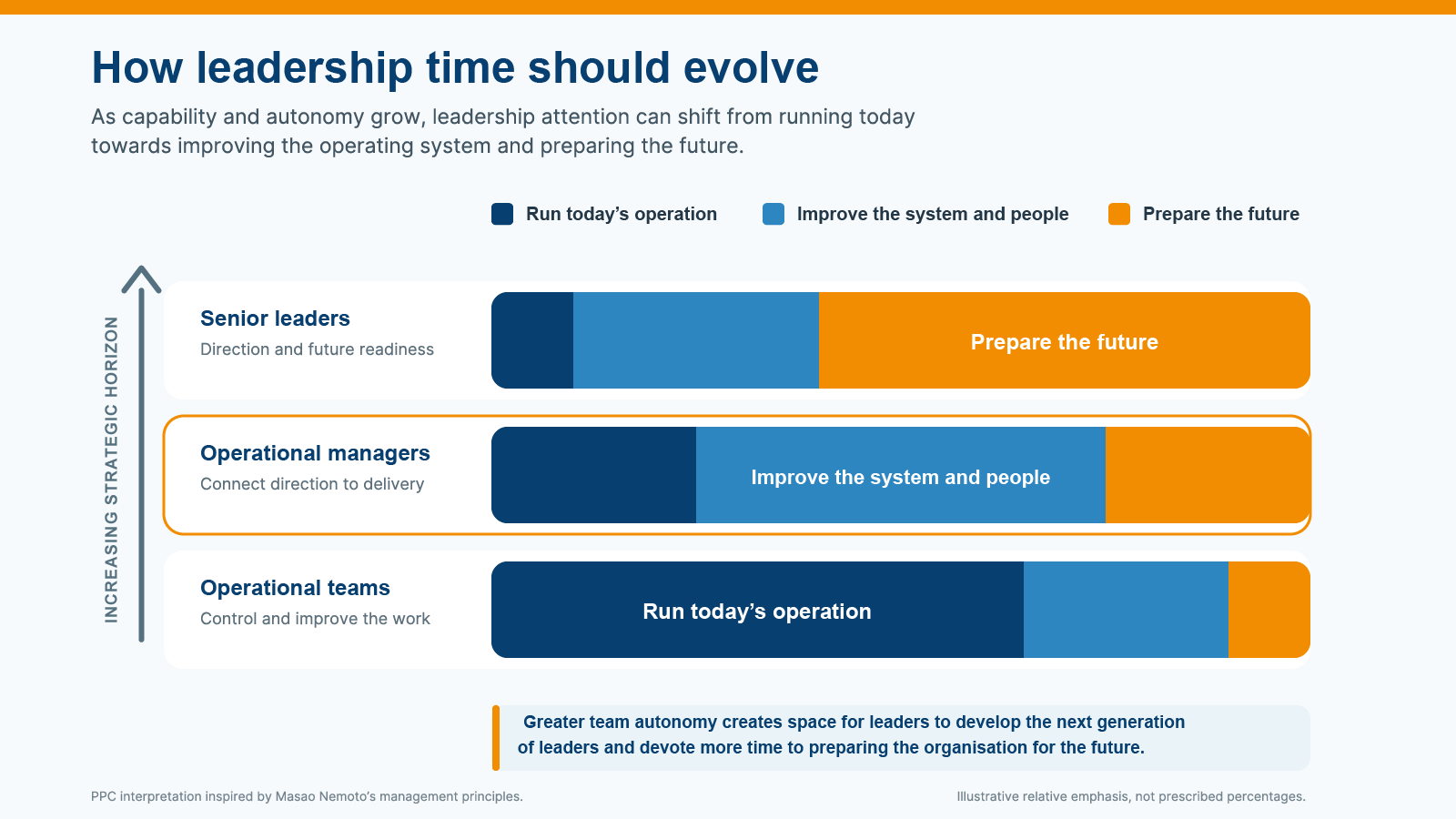
How leadership time should evolve
As teams become more capable and autonomous, leaders do not become less important. Their time shifts from repeatedly solving today’s problems towards improving the operating system, developing future leaders and preparing the organisation for the future. Adapted from the management principles illustrated by Masao Nemoto.
Clarifying Daily Management and Operational Strategy and Delivery
| Topic | Daily Management | Operational Strategy and Delivery |
|---|---|---|
| Primary Question | Are we on plan today | Are agreed improvements moving us towards the future state |
| Typical rhythm | Short interval, shift Daily | Weekly, monthly or milestones |
| Main focus | Current performance, protect the customer escalation |
Improvement actions, projects, dependencies and decisions |
| Typical participants | Operators, team leaders and operational managers | Leaders, functional owners, projects or improvement leads |
| Core visual | Team board, plan versus actual, escalation, tiered meeting, problem solving meeting | Obeya, master plan, KPI tree, Contract of objectives, A3 follow-up |
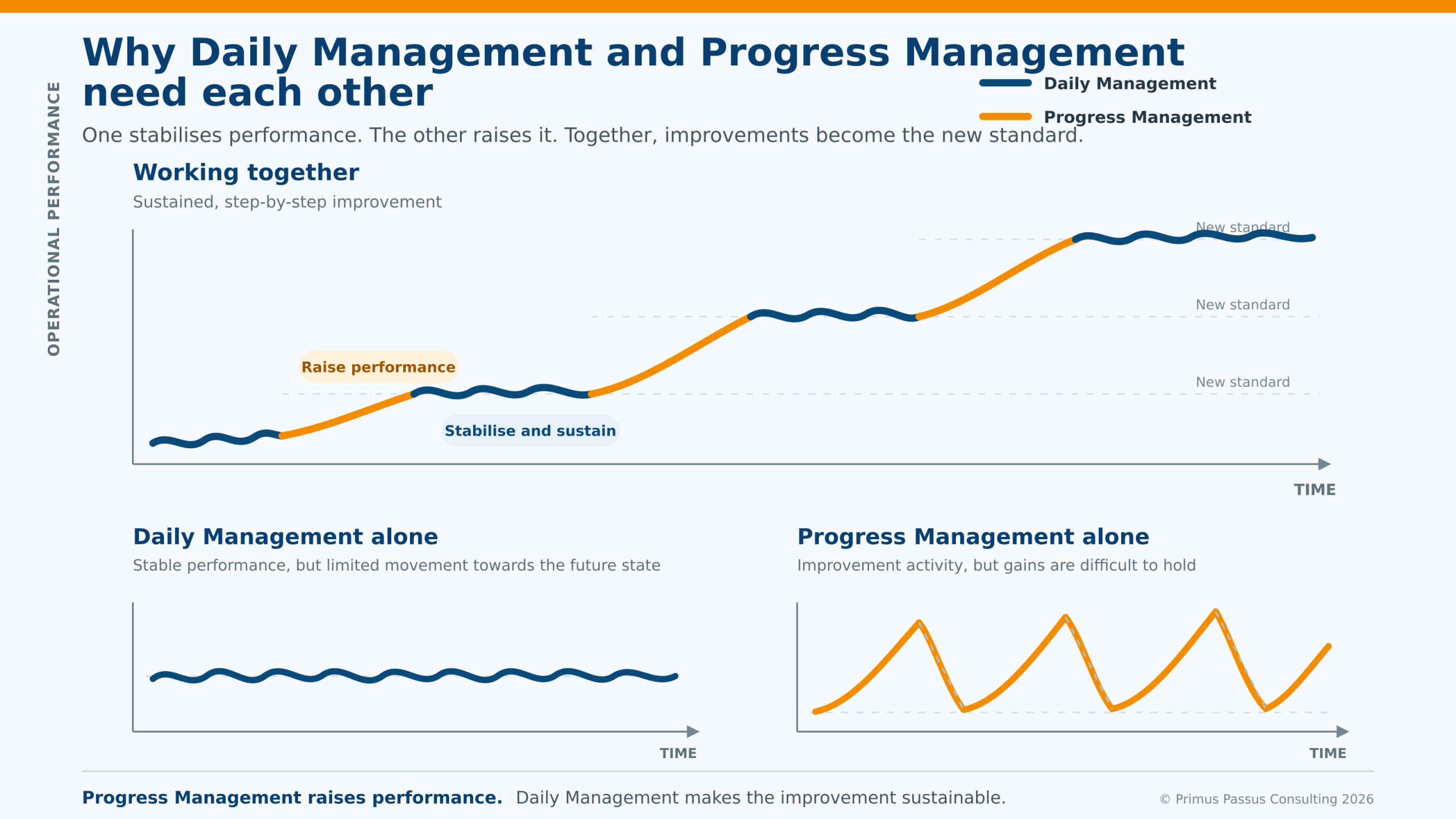
Why Daily Management and Progress Management need each other
Daily Management stabilises performance at the current standard, while progress Management creates the next improvement. Working together, they turn each gain into a sustainable foundation for further progress.
Not sure where to start?
What do you see when you look at your manufacturing process?
If you see constant firefighting, unstable delivery of products, shifting priorities or a sense that operation is harder to control than it should be, the first step is not to launch another action plan.
The first step is clarity, before deciding what to fix, you need to understand what is really happening.
Once you have identified that there is an issue to resolve, an operational review helps you identify the starting point. It looks at how the work flows through the business. identify the restraints and prioritise key actions. If not, resources and time will be spent on the wrong topic, at the wrong place.
At Primus Passus Consulting we help organisations move from firefighting to stable, controlled predictable operations.
Working with us
When it comes to manufacturing and production you don’t fix everything at once.
Trying to do too much too quickly often creates pressure for the people already holding the operation together. Real improvement comes from choosing the right starting point, making the work visible and building progress step by step.
Clients often find that it is the small, consistent changes, made over a period of time, that make the real difference, creating genuine improvement in flow, production, morale and results.
The advantage of small, consistent changes is that they’re less intrusive for the team and are learning opportunities, freeing up time to improve other areas of the business.