Services

Services

From stabilising operations to controlling, enabling flow, and building out your internal capabilities.

Stabilise, Control and Improve Performance

Primus Passus Consulting helps manufacturing businesses move from daily firefighting towards more stable, visible and predictable performance.

Our services are not isolated fixes. They work together as a connected system: helping you understand what is disrupting performance, regain control of day-to-day operations, improve flow and build the team’s capability to solve problems and sustain improvement.

Some clients begin with an Operational Review or a specific challenge. Where continuing support would add value, this can develop into a longer-term partnership, including fractional leadership support.

The aim is simple: fewer surprises, shared priorities, more reliable delivery and a stronger, more resilient operating system.
Practical Manufacturing Training and Capability Development

Our training is designed for manufacturing leaders, managers, team leaders, engineers and operational teams.

Courses can be delivered individually or combined into a bespoke capability pathway.

Wherever possible, participants work with their own performance information, equipment, routines and operational challenges so that learning is translated into practical application.

Operational Management and Team Capability

  • Daily Management and Visual Management for Manufacturing Teams

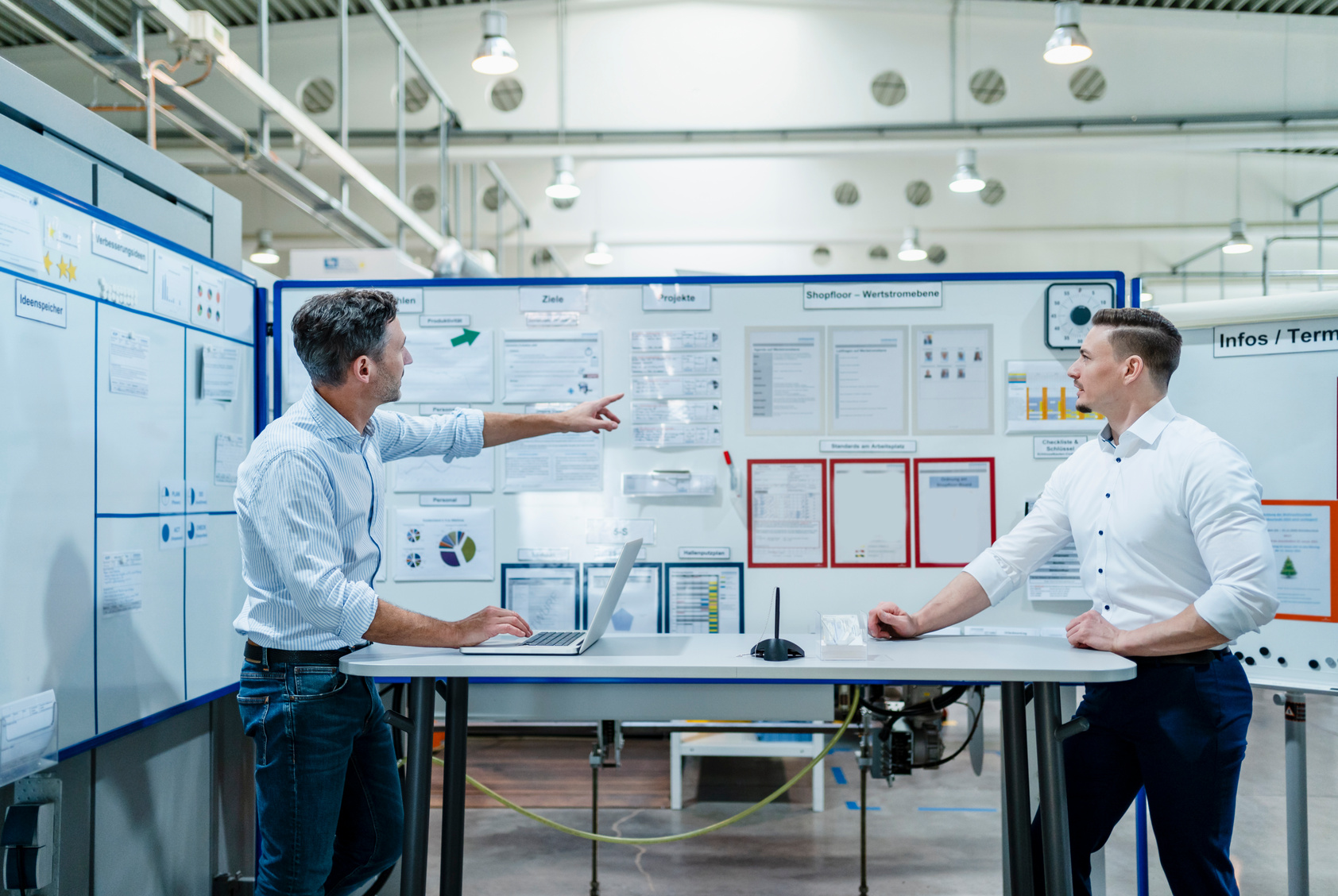
    Build effective daily routines that compare plans with actual performance, expose abnormalities and trigger action. The course can include team boards, leading and lagging indicators, short-interval control, tiered meetings, escalation and shop-floor leadership.

  • Progress Management: From Strategic Priorities to Delivery

    Turn strategic priorities and improvement objectives into a visible and manageable delivery plan.

    Participants learn how to structure a master plan, clarify ownership, manage dependencies and use regular progress reviews to maintain momentum.

  • Obeya, Master Plans and A3 Follow-up

    Create a shared space for reviewing priorities, projects, performance and decisions. The course explores effective Obeya design, visual master plans, A3 follow-up and the meeting routines needed to support delivery.

  • Practical Problem Solving Using PDCA and A3

    Move from symptoms and repeated containment to a structured understanding of causes.

    Participants practise defining the problem, analysing the current situation, identifying root causes, testing countermeasures and confirming sustainable results.

  • KPI Trees, Scorecards and Leading Indicators

    Connect strategic objectives with the operational measures and actions that influence them.

    Participants learn to build meaningful KPI trees and scorecards, distinguish leading from lagging indicators and avoid boards that simply report yesterday’s results.

  • Effective Gemba Walks and Leader Standard Work

    Develop purposeful management routines for observing work, understanding problems and supporting teams. The course helps leaders distinguish a useful Gemba walk from an inspection or unstructured factory tour.

  • Team Leader Foundations

    Strengthen the practical skills required to coordinate daily operations. Topics can include briefings, priorities, escalation, shift handovers, constructive feedback, problem-solving support and leader standard work.

  • Skills Matrices and Capability Development

    Make current and required capability visible, identify operational vulnerabilities and plan development. Participants learn how to create and use practical skills matrices without turning them into administrative exercises.

  • Leading and Sustaining Operational Change

    Help people understand, test, adopt and sustain new ways of working. The course covers engagement, communication, pilots, feedback, ownership and the management routines required after implementation.

Lean Manufacturing, Flow and Throughput

  • Value Stream Mapping for Manufacturing Flow

    Use Value Stream Mapping (VSM) to understand how materials and information move through the operation. Participants identify delays, excessive inventory, disconnected processes and practical priorities for improving flow.

  • Bottleneck Management and Throughput improvement

    Identify the constraint that currently limits output and organise work around it. The course explores bottleneck protection, capacity losses, work-in-progress, sequencing and the principles of the Theory of Constraints (TOC).

  • OEE and TEEP for Performance Improvement

    Use Overall Equipment Effectiveness (OEE) and Total Effective Equipment Performance (TEEP) to understand availability, performance and quality losses. The emphasis is on using the measures to select improvement priorities rather than merely producing another dashboard.

  • SMED and Changeover Reduction

    Apply Single-Minute Exchange of Die (SMED) principles to reduce changeover time and variability.

    Participants observe the current changeover, separate internal and external activities and develop practical improvements with the people performing the work.

  • 5S and Visual Workplace Management

    Create workplace conditions that make the correct way of working easier and abnormalities easier to see. The course positions 5S as an operational management discipline rather than a one-off cleaning exercise.

  • Spaghetti Diagrams and Workplace Layout Improvement

    Visualise the movement of people, materials and information to identify unnecessary travel, handling and interruption. Participants use the analysis to improve workplace layout and flow.

Equipment Reliability and Maintenance

  • Total Productive Maintenance Foundations

    Introduce Total Productive Maintenance (TPM) as a shared approach to equipment reliability. The course clarifies the respective roles of operators, maintenance teams and leaders in maintaining basic conditions and preventing deterioration.

  • Breakdown Analysis and Recurring Failure Reduction

    Develop a consistent approach to equipment failures, from immediate containment through to root-cause analysis and permanent countermeasures. The focus is on preventing the same failures from returning.

  • Preventive Maintenance Optimisation

    Improve preventive maintenance content, frequency and effectiveness using evidence from failures, equipment condition and operational risk. The course can introduce Reliability-Centred Maintenance (RCM) and Condition-Based Maintenance (CBM) where appropriate.

  • Maintenance Strategy and Reliability Framework Development

    Define how equipment should be maintained according to operational criticality, failure consequences and business requirements. Participants establish clear principles, responsibilities and priorities for the reliability system.

  • CMMS Requirements, Implementation and Effective Use

    Define or improve the use of a Computerised Maintenance Management System (CMMS). Topics may include functional requirements, asset structures, work-order management, preventive maintenance, data quality, spare parts and management reporting.

  • Maintenance KPIs and Reliability Dashboards

    Select and use maintenance measures that support better decisions. The course can include Mean Time Between Failures (MTBF), Mean Time to Repair (MTTR), preventive-maintenance compliance, backlog, recurring failures and schedule adherence.

  • Planned Shutdown and Turnaround Management

    Prepare and control planned maintenance shutdowns so that safety, scope, resources, parts, contractors and restart risks are managed effectively.

  • Managing Outsourced Maintenance Contracts

    Clarify service expectations, responsibilities, performance measures, escalation and review routines for subcontracted maintenance activities.

How the services work together

The sequence is practical.

Operational Review

First, understand the situation.

A clear starting point and an agreed plan.

A shared view of the current situation, the priorities that matter and the actions to take first. 

Daily Management

Then stabilise the operation.

Quicker decisions. Fewer surprises. Greater Control.

Teams can act earlier, escalate what needs support and anticipate the next shift or day. 

Flow and Throughput

Then create visibility and control.

More reliable output from the capacity you already have.

Less waiting, shorter lead times and better use of people, equipment and space.

Team Capability & Problem Solving

A team that can sustain improvement itself.

Greater autonomy and better decisions, with the capability to solve problems as our direct involvement reduces. 

Operational Strategy

Then build the internal capability to sustain progress.

Clearer priorities. Fewer stalled actions. Visible progress. 

Leaders can resolve obstacles, coordinate effort and keep agreed improvements moving towards the future state.

Equipment Reliability

Then improve flow.

Fewer avoidable interruptions. More confidence in the production plan. 

Better use of maintenance time and spares, with equipment available and capable when needed. 

Not every business needs every service in the same way. The starting point depends on the level of instability, the pressure on the team and the priorities of the business.

To discuss where your operation is losing stability, control or flow, get in touch with Primus Passus Consulting.

Go to Top